Investigator’s Toolbox
This section provides an introduction to the tools investigators carry on site, and their uses. Please refer to your organization’s protocols, since different investigative organizations may require you to carry different tools. This is intended to be an introductory guide; Investigators are responsible for their toolkit, and using the tools safely. Do not use a tool if you are unsure on how to use it safely.
Investigators may also carry different tools for different types of fires. For example, the editor of this page would normally take a full socket set to a vehicle fire, but not to a structure fire.
Note that this section focuses on tools for fire investigations, not personal protective equipment. Refer to the section on Physical Health and Safety under Health and Safety for more information on personal protective equipment including respiratory equipment. and protective clothing.
Cameras
The importance of good photography equipment cannot be overemphasized in any fire investigation. The investigator must make use of camera and video equipment whenever on scene in order to document the the scene as found, and to document the investigation and evidence as found.
A powerful flash (many fire investigator use an external flash) is a very useful tool given the lack of light and dark colours in most fire scenes.
Many fire investigators opt to have a normal (DSLR, mirrorless) high-resolution camera with an 18-55mm kit lens , and a point-and-shoot camera with macro capabilities (such as the Olympus TG-6) to take macro photos and also act as a backup camera in case of a failure of the primary camera.
All photos, whether they be digital images or video must be analyzed and maintained in a secure storage medium in order to that they can be useful as evidence or for any future reporting needs.
Lighting
Even during the daytime, structure fire scenes are often in locations where power has been cut off and there is little lighting. Investigators need to arrange good, strong lighting to ensure safety and to be able to see well enough and not miss crucial evidence.
Generally, a large tripod-mounted light strong enough to light up a room, a hand-held flashlight to look at specific items, and a headlamp for hands-free use are recommended. Brands like Milwaukee and DeWALT have all kinds of lighting mentioned here.
Remember to keep your batteries charged and have backups if possible.
Digging
A shovel is essential to dig through fire scenes which could have fire damaged drywall, wood, and insulation over items of interest. Collapsible shovels are available for transport on airlines or in personal vehicles.
Along with a shovel, a rake is essential to sift though the debris and/or to make the debris loose so it is easier to shovel. Directly shovelling fine debris may lead to important pieces of evidence being shovelled away with the debris. Using a rake to sift through the debris before shovelling may be beneficial in some situations.
Hand Tools
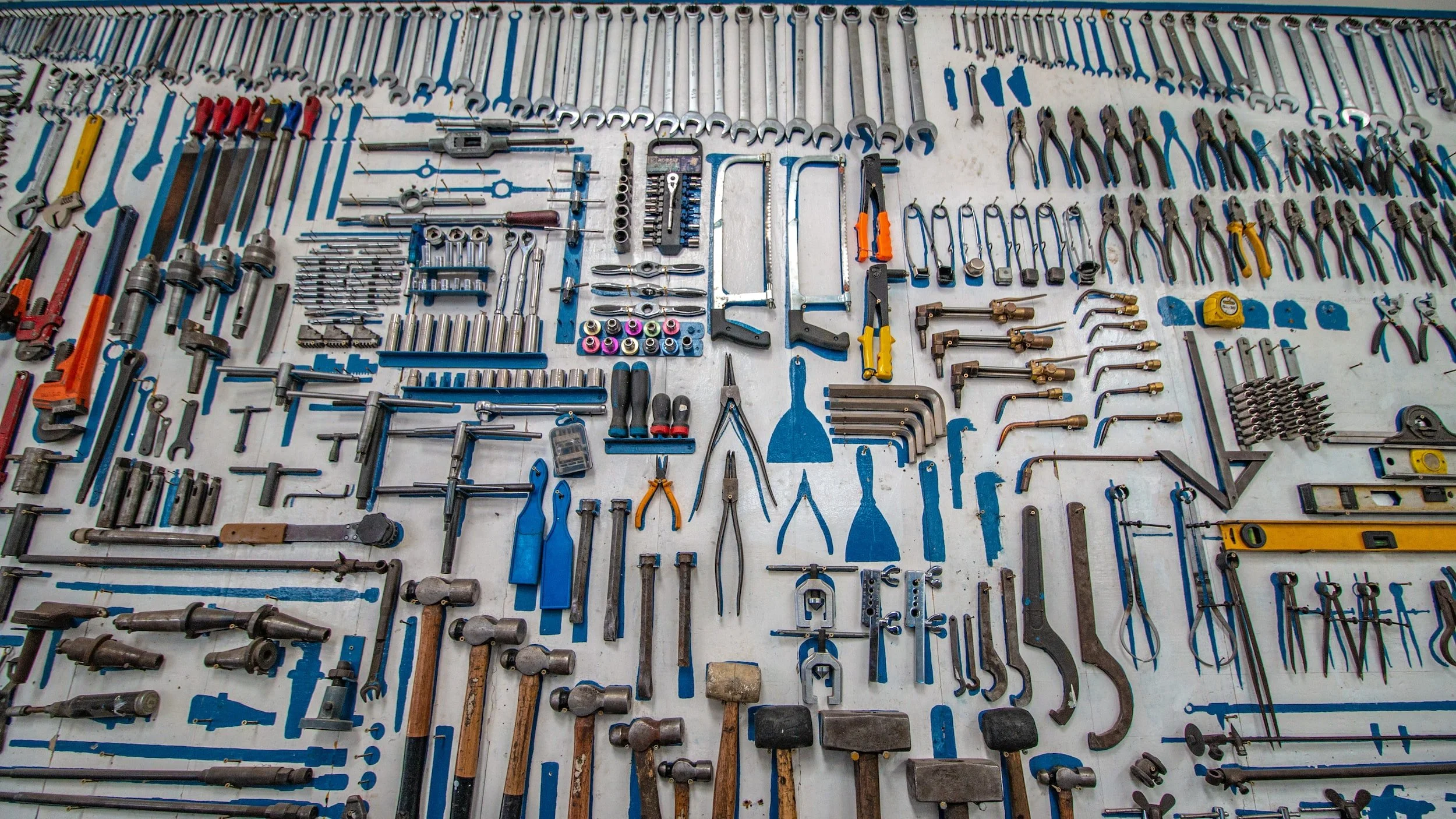
Among other things, an investigator requires hand tools for disassembly, partial demolition to observe items of interest, and evidence collection. A basic toolbox should comprise of:
Multi-bit screwdrivers (with bits compatible with a power drill)
Linesman pliers
Needle-nose pliers
Hammer
Mallet
Pry bar
Wire cutters
Tin snips
Razor blade knifes with break off blades
Other items, including an axe, sledgehammer, pickaxe may be added.
Vehicle Fires
In addition to the other items on this page, a good trolley jack (make sure to see the weight rating is appropriate), jack stands, and a socket set may be used for vehicle fires.
Power Tools
Battery-operated power tools are highly useful at fire scenes. A reciprocating saw can assist in removing obstructions and securing evidence, and a power drill can assist in removing boarding to access a fire scene or disassemble components. However, power tools should be operated with extreme caution.
Power drill
Reciprocating saw
Circular saw
Remember to keep your batteries charged! Many investigators prefer to keep power tools and lighting of the same manufacturer and have interchangeable batteries.
The usefulness of a generator or a portable 12 Volt electric power inverter is increasingly more important when at a fire scene in a remote location. Power inverters typically run off of 12 V power supply such as a vehicle battery from a 120 V power outlet and can be used to recharge lights, small power tools, a laptop and camera batteries.
Measurement Devices
Two measuring tapes (investigators may want to put two tapes in two different axes to take photos showing both horizontal and vertical dimensions of an item or pattern), a laser distance measurer, and small rulers for photographs.
Evidence Gathering Tools
In order to successfully gather evidence at any fire scene the investigator requires innovation and understanding of these very intricate tools. Since the fire investigation requires a number of specialized tools in collection of evidence, adaptability in this section is required. Some of the tools include:
Resealable sandwich bags (for small items)
Large contractor plastic bags (for larger items)
Plastic wrap (‘ClingWrap‘)
Mason jars
Nylon evidence bags (for samples to be potentially tested in a lab for ignitable liquids or other tests)
Labels
Coloured sharpie markers
Stick chalk
Scissors
Syringe
Coloured rolls of electrical tape
Coloured zip ties
Rulers and perimeter markers
Twine
Sterile gauze pads
Sterile sample vials
Stiff bristle whisk
Paint brushes
Refer to NFPA 921 for information on how to collect evidence.
High Tech Equipment
Technological advance have resulted in a growing number of tools that can be of assistance to the Investigator. Some tools are useful for documentation while others may assist in identification of items of evidence. Some of these tools are expensive, and access may depend on the investigators organization. The following are a few examples of equipment that Fire Investigators may use:
Drone cameras are being used increasingly in fire investigations. they can provide an overall view of the fire scene, help identify fire patterns not readily visible from foot, and assist in assessing structural damage to know if a scene is safe to enter.
Portable hydrocarbon detectors can identify areas to take samples from, which can be sent for lab analysis. Note that portable hydrocarbon detectors do not replace lab testing to confirm presence of ignitable liquids.
Digital Video Recorders
Digital Voice Recorder
iPad or other Tablets can be useful for taking notes, referring to documents on-the-go, and helpful in annotating photographs on-site.
Smart phones have cameras which can be used in smaller spaces. Modern smartphones also have 3D scanning features which can create efficient floor plans, and document fire patterns or items of evidentiary value in all dimensions to paint a better picture than multiple photographs.
Thermal cameras can be used to ensure there are no active hotspots during a fire investigation, and during evidence examinations to see if equipment is generating abnormally high temperatures.
With laptop computers, smart phones, and tablets, fire investigators can use a variety of software ands web based programs to stay in contact with their clients, head office, and other agencies. Scanning the Internet for referral or information also is performed with relative ease from the investigators vehicle if need be.
Do you have any tools you have found useful at fire scenes and would like to share? Let us know!